

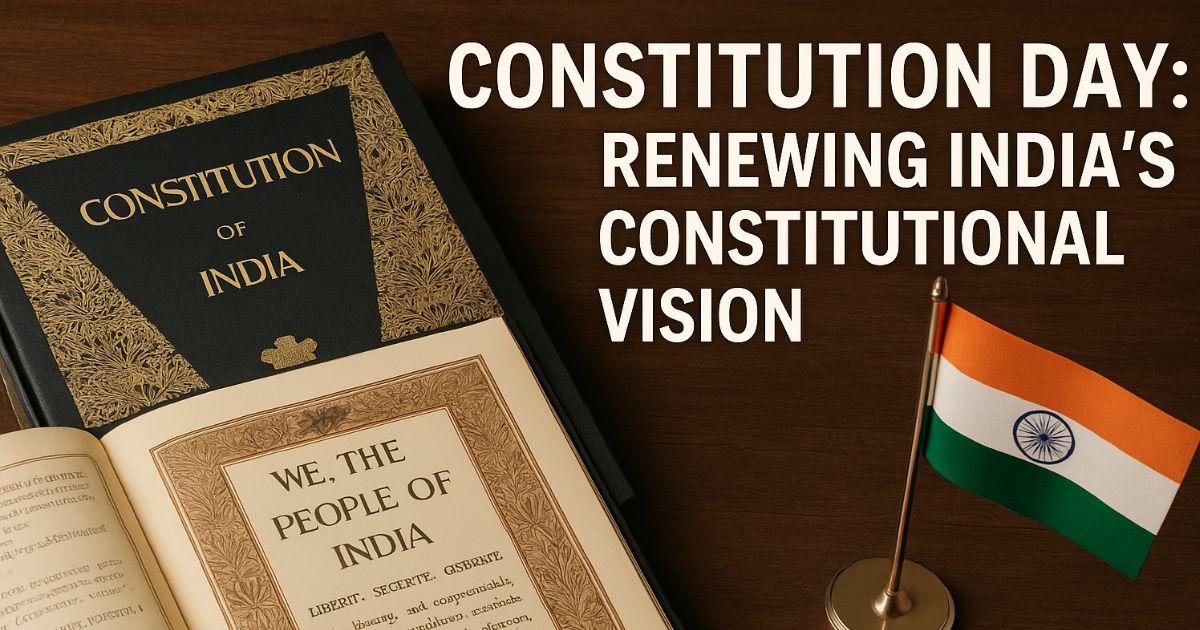
Constitution Day is more than a commemoration of the foresight of India’s founding fathers. It is a moment to reflect on how their vision must evolve as India aspires to become a developed nation. The journey from a newly independent republic to a confident, rapidly growing country demands a constitutional discourse rooted in civilisational ethos, while remaining firmly committed to justice, liberty, equality, and fraternity.
Revisiting the Spirit of Constitution Day:
Observed on 26 November, Constitution Day marks the adoption of the Constitution in 1949. It reminds citizens that the Constitution is not a static legal code but a living instrument—designed to respond to changing social and economic realities while safeguarding democracy, rule of law, and fundamental rights.
Civilisational Values Meet Modern Aspirations:
India’s five‑millennia-old civilisation has nurtured ideas of dharma, pluralism, community life, and respect for nature. These values can enrich constitutional guarantees by infusing them with responsibility, restraint, and inter-generational justice.
A forward-looking reform agenda must harmonise modern rights discourse with indigenous traditions of social obligation and ecological balance. This synthesis can produce a uniquely Indian model of development—authentic, rooted, and not a mere imitation of Western modernity.
From Freedom to Development:
The founding generation prioritised political freedom, unity, and social transformation. Today, the challenge is to build a knowledge-driven, high‑productivity economy while ensuring growth remains inclusive and sustainable.
This requires constitutional clarity on:
Long-term infrastructure planning
Innovation and technology
Environmental protection
Cooperative federalism empowering states and local bodies
Debates must move beyond identity politics to embrace these pressing governance imperatives.
Beyond Identity Politics:
While the Constitution rightly addresses historical injustices, public discourse has often narrowed to caste or religion-based bargaining. This diverts attention from universal concerns such as education, healthcare, livelihood security, gender justice, and environmental protection.
A shift towards socio‑economic constitutionalism is needed—prioritising human development, equal access to opportunities, and dignity for all. Protective provisions must serve as bridges to equality, not permanent tools of fragmentation.
Socio‑Economic Balancing as Priority:
The Directive Principles of State Policy envision a welfare state, yet remain weakly implemented. Reform could include:
Stronger commitments to universal education, healthcare, nutrition, and social security
Recognition of the right to livelihood, skill development, and fair wages
Mechanisms to measure and reduce socio‑economic disparities with time-bound targets
Such measures would translate the Preamble’s promise of justice—social, economic, and political—into tangible guarantees.
Sustainability as a Constitutional Cornerstone:
Industrialisation and urbanisation make sustainability inseparable from justice. Climate vulnerability and ecological inequities disproportionately affect the poor and future generations.
Reform could:
Elevate environmental protection and climate resilience into enforceable duties
Promote cooperative federalism on water, forests, energy, and urban planning
Duties, Ethics, and Public Spirit
Fundamental Duties remain largely symbolic. Revitalising them—towards the nation, harmony, and environment—can bridge the gap between rights and responsibilities, reflecting India’s age‑old emphasis on dharma.
A developed India will be defined not only by income but by the character of its public life: integrity in institutions, civic discipline, respect for diversity, and concern for the weakest.
Towards Civilisational Constitutionalism:
The task is not to discard the Constitution but to deepen and renew it in light of civilisational wisdom and contemporary challenges. Reform should be guided by three touchstones:
Does it strengthen India’s unity and integrity?
Does it advance socio‑economic opportunities and dignity for all citizens?
Does it resonate with India’s cultural ethos of harmony and responsibility?
Conclusion:
On this Constitution Day, the call is to envision an India that is modern yet rooted, prosperous yet compassionate, powerful yet principled—a developed nation whose constitutional framework reflects both the demands of the present and the timeless values nurtured over 5,000 years of civilisation.
Prepared by:
Adv. Anil Thomas,
Sr. Partner,
Belverdia Legal LLp, Cochin, Kerala.
www.belverdialegal.com.
