

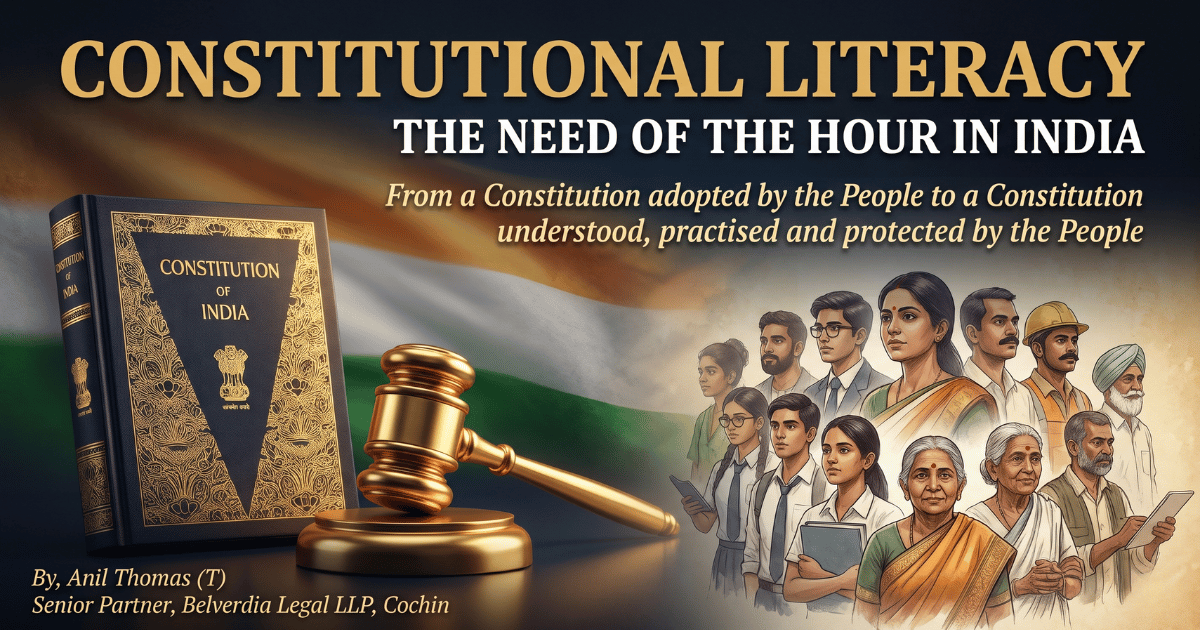
From a Constitution adopted by the People to a Constitution understood, practised and protected by the People
By, Anil Thomas (T)
Senior Partner,
Belverdia Legal LLP, Cochin
1. The Constitution belongs to the People
The Preamble to the Constitution of India begins with the historic declaration: “WE, THE PEOPLE OF INDIA”. These words are the foundation of our sovereign democratic Republic. The Constitution was framed and adopted by the Constituent Assembly on behalf of the People, who thereby gave themselves a constitutional framework founded upon Justice, Liberty, Equality and Fraternity.
The Constitution is not the exclusive domain of lawyers, judges, legislators or administrators. It belongs to the People, derives its authority from them and exists to secure their collective and individual aspirations.
A Constitution given to the People must also be made intelligible, accessible and meaningful to the People.
That is the essence of Constitutional Literacy.
2. Are we fulfilling the spirit of the Constitution?
India has developed an extensive legal framework, elected legislatures, an independent judiciary, constitutional institutions and a substantial administrative structure. Yet, a fundamental question deserves serious consideration:
Do our present levels of constitutional awareness, legislative responsibility, judicial accessibility and executive performance adequately reflect the spirit and aspirations of the Constitution?
The gap is often not the absence of laws, but the distance between the law and the life of the ordinary citizen.
Legislatures must make laws consistent with constitutional values and public interest. The Executive must translate constitutional promises into accessible public services and accountable administration. The Judiciary must safeguard constitutional rights while ensuring meaningful access to justice. The legal profession and educational institutions must help bridge the gap between legal knowledge and public understanding.
Democracy cannot function effectively through voting alone. It requires informed, responsible and continuous citizen participation.
3. The Constitution as an instrument of social and economic transformation
The Constitution is not merely a framework for distributing governmental powers; it is also an instrument of social transformation.
Part III guarantees Fundamental Rights, while Part IV contains the Directive Principles of State Policy (DPSPs), which guide the State in building a just social and economic order.
Article 37 declares that the Directive Principles are not enforceable by courts, but are nevertheless fundamental in the governance of the country and it is the duty of the State to apply them in making laws.
Provisions such as:
- Articles 38 and 39: Social and economic justice, reduction of inequalities, livelihood and equitable distribution of resources.
- Article 39A: Equal justice and free legal aid.
- Article 40: Organisation of village Panchayats.
- Articles 41-43: Work, education, public assistance, humane working conditions and living wages, subject to the constitutional qualifications.
- Articles 45 and 46: Early childhood care, education and protection of weaker sections.
- Article 47: Nutrition, public health and standard of living.
- Article 48A: Protection of the environment, forests and wildlife.
These principles must translate into tangible improvements in education, healthcare, livelihood, social security, environmental protection and human dignity.
A constitutionally informed citizen can understand the objectives behind public welfare policies, assess their implementation and participate in demanding better governance.
The true measure of constitutional governance is not merely the number of laws enacted, but the extent to which constitutional values improve the quality of life of the People.
4. Fundamental Rights and Fundamental Duties: Constitutional Harmony
Fundamental Rights protect liberty, equality and dignity. Fundamental Duties under Article 51A remind citizens of their responsibilities towards the Constitution, the Nation, society, fellow human beings and the environment. These are complementary dimensions of responsible citizenship.
Citizens must understand that freedom carries responsibility; equality demands respect for the dignity of others; fraternity requires harmony; and environmental protection requires collective commitment.
Fundamental Duties do not, by themselves, authorise arbitrary restrictions upon Fundamental Rights. Rights may be restricted only on constitutionally and legally valid grounds.
The constitutional vision is not a conflict between rights and duties, but a harmonious society in which every individual’s rights are respected and every citizen contributes responsibly to the common good.
5. Taking Constitutional Literacy to the common citizen
Constitutional Literacy must move beyond textbooks, courtrooms and academic institutions into homes, villages, neighbourhoods, workplaces and public spaces.
A structured, continuous and non-partisan national programme should include:
- Grassroots outreach: Regular constitutional awareness sessions through Gram Sabhas, Ward Sabhas, Panchayats, Municipalities, schools, colleges and community institutions.
- Citizen’s Constitutional Guide: A simple, multilingual handbook explaining Fundamental Rights, Fundamental Duties, constitutional institutions, local governance and available legal remedies.
- Practical learning: Everyday examples concerning public services, discrimination, environmental protection, welfare entitlements, RTI and access to justice.
- Digital accessibility: A national multilingual portal and mobile application containing verified information, short learning modules, explanatory videos and links to official grievance-redressal and legal-aid platforms.
- Inclusive participation: Special outreach for women, children, senior citizens, workers, farmers, tribal communities, persons with disabilities and economically weaker sections.
- Community engagement: Mobile Constitutional Literacy Clinics, public libraries, local-language media and trained community volunteers.
The objective must not be to make citizens memorise constitutional provisions, but to help them understand how the Constitution operates in their everyday lives.
6. Constitutional Literacy and public accountability
A public office is a public trust. Constitutional Literacy enables citizens to understand the limits of public power and the responsibilities of public authorities.
An informed citizen can use the Right to Information Act, participate in Gram Sabhas and Ward Sabhas, examine public expenditure and audit reports, question elected representatives, approach grievance-redressal authorities, seek legal aid and pursue lawful remedies before competent institutions.
This does not mean interference with the independent functioning of constitutional institutions. It means enabling citizens to demand transparency, fairness, reasoned decisions and accountability through established democratic and legal mechanisms.
The objective is not confrontation between the citizen and the State, but a constitutional partnership in which public authority remains accountable to the People.
7. Law students: From constitutional knowledge to community service
Law schools have a special responsibility to take constitutional knowledge beyond the classroom.
It is proposed that every recognised law school introduce a mandatory final-semester programme titled “Constitutional Literacy, Civic Engagement and Community Legal Outreach”, subject to the applicable Bar Council of India and university framework.
The programme should carry academic credits and include:
- Study of the Preamble, Fundamental Rights, Directive Principles, Fundamental Duties and constitutional institutions.
- Preparation of simplified constitutional guides in regional languages.
- Study of a public institution and its accountability mechanisms.
- Supervised constitutional awareness sessions in villages, wards, schools or communities.
- Practical assignments on RTI, legal aid, public grievance mechanisms and local governance.
- A final community-based project identifying constitutional awareness gaps and recommending solutions.
Each student should submit a community-needs assessment, educational material, evidence of outreach and a final report.
This will help develop not merely competent lawyers, but socially conscious legal professionals who understand the Constitution as a living instrument of public service.
8. A coordinated National Constitutional Literacy Mission
Constitutional Literacy must become a coordinated responsibility of all three levels of government:
- Union Government: Establish a National Constitutional Literacy Mission, develop common standards, provide financial and technological support, create a multilingual national portal and publish periodic national assessments.
- State Governments: Establish State-level implementation authorities, prepare regional-language learning materials, coordinate educational institutions and Legal Services Authorities, and train district-level resource persons.
- Local Self-Government Institutions: Make Panchayats and Municipalities the principal grassroots platforms through Gram Sabhas, Ward Sabhas, community libraries, public consultations and local development programmes.
The 73rd and 74th Constitutional Amendments provide the framework for decentralised local governance. Constitutional Literacy should become an integral part of meaningful democratic participation at this level.
9. A statutory National Constitutional Literacy Authority
For continuity, institutional accountability and measurable outcomes, it is proposed that a National Constitutional Literacy Authority be established through an appropriate legislative framework, with corresponding State-level authorities and local implementation structures.
The Authority should have representation from constitutional and public-law experts, Union and State Governments, legal education institutions, Local Self-Government Institutions, Legal Services Authorities, civil society and community organisations.
It should:
- Develop standardised, accurate and non-partisan learning resources.
- Establish district-level Constitutional Literacy Centres.
- Train and accredit Constitutional Literacy Volunteers.
- Engage NGOs, bar associations, universities and community organisations.
- Provide transparent grants and institutional support.
- Maintain a national register of trained volunteers and partner institutions.
- Develop a National Constitutional Literacy Index to measure awareness, accessibility and citizen participation.
- Publish annual reports and ensure independent evaluation.
The proposed framework must respect India’s federal structure, the Concurrent List and the constitutional and statutory powers of State and Local Self-Government Institutions.
10. The way forward: A Constitution that is understood and lived
India does not merely need citizens who know that a Constitution exists. It needs citizens who understand what it stands for, how its institutions function and how its promises can be realised in everyday life.
Constitutional Literacy can reduce avoidable social conflict, strengthen fraternity, promote respect for diversity, protect the environment and improve democratic accountability. It can bridge the distance between constitutional ideals and the lived realities of the common person.
The Constitution must not remain confined to libraries, courtrooms, legislative debates or administrative files. Its values must be reflected in public administration, institutional conduct and the everyday lives of citizens.
The Constitution is not merely a document that the People possess. It is a living covenant that every generation must understand, exercise, protect and transmit to the next.
CONSTITUTIONAL LITERACY IS THE KEY TO FREEDOM.
An informed citizen is an empowered citizen.
An empowered citizen is the foundation of accountable governance.
Accountable governance is the strength of a living democracy.WE, THE PEOPLE
KNOW THE CONSTITUTION. LIVE THE CONSTITUTION.
